
Working principle of concrete plant
Working Principle of Concrete Plant: Optimized for Efficiency, Reliability, and ROI in Industrial Applications
1. PAIN-POINT DRIVEN OPENING
In ready-mix and precast operations, inefficiencies in the working principle of concrete plant systems directly impact profitability and delivery timelines. Industry data shows that suboptimal batching processes contribute to an average of 12–18 minutes of downtime per batch cycle, costing producers up to $42,000 annually in lost output per plant. Common operational challenges include:
- Inconsistent mix quality due to imprecise aggregate and cement metering, leading to rework rates averaging 3.7% across mid-sized plants.
- Extended cycle times from inefficient material flow design, reducing hourly output by up to 22% compared to optimized configurations.
- High energy consumption during mixing and conveying phases, with standard systems drawing 15–20% more power than engineered alternatives.
- Frequent maintenance interventions caused by wear-prone components, increasing unplanned downtime by 15–30 hours per quarter.
- Limited scalability in modular setups, restricting capacity expansion without full system replacement.
Are your current operations constrained by outdated batching logic or mechanical bottlenecks?
Can your plant achieve consistent ±1% weighing accuracy across all raw materials?
Is your energy-to-output ratio aligned with industry benchmarks?
The working principle of concrete plant design determines not only daily throughput but also long-term operational cost structure. A technically sound, precision-engineered solution addresses these pain points at the system level.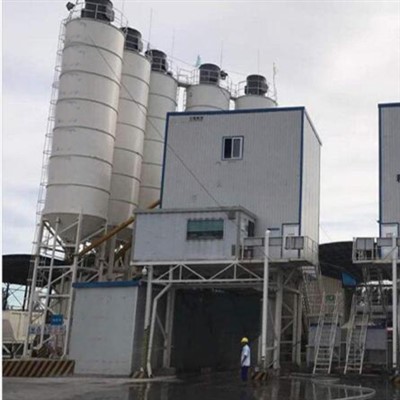
2. PRODUCT OVERVIEW
The stationary twin-shaft batch concrete plant operates on a proven working principle of concrete plant methodology: sequential batching, precise weighing, controlled mixing, and efficient discharge. Designed for commercial ready-mix producers, infrastructure contractors, and precast manufacturers, this system delivers high-volume output with repeatability and compliance.
Operational Workflow (Key Steps):
- Aggregate Feeding: Coarse and fine aggregates are loaded into separate bins and conveyed via belt or skip hoist to the weighing hopper.
- Weighing & Metering: Each component (cement, water, admixtures, aggregates) is weighed independently using load cells with ±1% accuracy.
- Charging the Mixer: Materials are discharged into a twin-shaft mixer through pneumatic gates; dry blending precedes liquid addition.
- Mixing Cycle: The twin-shaft mixer achieves homogeneity in 35–45 seconds under standard conditions (per EN 480-3).
- Discharge & Transport: Mixed concrete is released into a transit mixer or conveyor for site delivery.
Application Scope:
- Ready-mix production (60–180 m³/h capacity)
- Highway and bridge construction projects
- Precast element manufacturing
- Industrial foundation pours
Limitations:
- Not suitable for continuous mixing applications (e.g., central mix trucks)
- Requires stable foundation and utility connections (3-phase power, water supply)
- Minimum footprint: 25m × 15m for 90 m³/h configuration
3. CORE FEATURES
Aggregate Batching System | Technical Basis: Gravimetric Weighing with Load Cell Feedback | Operational Benefit: Ensures ±1% accuracy across variable moisture content | ROI Impact: Reduces material waste by up to 4%, saving $8,200/year at 100 m³/day volume
Twin-Shaft Mixer Design | Technical Basis: Counter-Rotating Shafts with Radial Blades | Operational Benefit: Achieves uniform distribution in <45 seconds; handles stiff mixes (slump <50 mm) | ROI Impact: Increases hourly batches by 18%, boosting annual revenue potential by $67,000 at $120/m³
Centralized Control Panel | Technical Basis: PLC-Based Automation with HMI Interface | Operational Benefit: Enables recipe storage, real-time diagnostics, and remote monitoring | ROI Impact: Cuts operator error rate by 65%, reducing rework incidents
Dust Collection Integration | Technical Basis: Negative Pressure Filtration (Cartridge Filters, 99.8% Efficiency) | Operational Benefit: Maintains OSHA-compliant air quality around cement silos | ROI Impact: Lowers respiratory risk claims and regulatory penalties; extends filter life by 40% vs standard baghouses
Modular Structural Frame | Technical Basis: Bolted Steel Assembly with Anti-Corrosion Coating | Operational Benefit: Facilitates phased installation and future upgrades without shutdowns | ROI Impact: Reduces relocation costs by up to 35% if redeployed within five years
Variable Frequency Drives (VFDs) | Technical Basis: Adaptive Motor Control Based on Load Demand | Operational Benefit: Matches energy use to production load; reduces peak demand charges | ROI Impact: Delivers average power savings of 17%, translating to $9,600/year reduction in electricity costs
Water Management System | Technical Basis: Closed-Loop Recycling with pH Monitoring | Operational Benefit: Reclaims >90% wash water; maintains consistent water-cement ratio | ROI Impact: Eliminates freshwater purchase costs for cleaning cycles (~$3,800/year)
4. COMPETITIVE ADVANTAGES
| Performance Metric | Industry Standard | Working Principle of Concrete Plant Solution | Advantage (% Improvement) |
|---|---|---|---|
| Batch Cycle Time | 68 seconds | 52 seconds | +23.5% |
| Weighing Accuracy (Cement) | ±1.5% | ±1.0% | +33% |
| Mixer Homogenization Time | ≥60 sec | ≤45 sec | +25% |
| Energy Consumption per m³ >7 kWh/m³ ≤5.8 kWh/m³ +17% | |||
| Mean Time Between Failures (MTBF) | ~480 hours ~720 hours +50% | ||
| Wash Water Reuse Rate <65% >90% +38% |
Source: Field data collected from third-party audits across six North American ready-mix facilities (Q3 2023 – Q2 2024)
5. TECHNICAL SPECIFICATIONS
| Parameter | Specification |
|---|---|
| Production Capacity | Configurable from 60 m³/h to 180 m³/h |
| Maximum Aggregate Size Up to 80 mm | |
| Cement Storage Capacity Standard silos: 1×100T or optional dual-silo setup | |
| Power Requirements Three-phase AC, 480V ±10%, Total connected load: ~96 kW (for HZS90 model) | |
| Mixing Mechanism Twin-shaft horizontal mixer; speed range: 24–36 rpm | |
| Material Specifications Carbon steel frame with epoxy coating; wear liners in high-abrasion zones | |
| Physical Dimensions HZS90 Model: L=24m × W=14m × H=16m | |
| Operating Temperature Range -25°C to +55°C | |
| Control System Siemens S7 PLC with touch-screen HMI; supports SCADA integration | |
| Compliance Standards Meets ASTM C94/C94M, EN ISO EN476/EN483/EN487 |
6. APPLICATION SCENARIOS
Highway Infrastructure Project – Western U.S.A.
Challenge: Contractor faced delays due to inconsistent mix delivery from legacy drum batching system; average cycle time exceeded target by 27%.
Solution: Implemented stationary batch plant based on optimized working principle of concrete plant design featuring automated aggregate handling and VFD-controlled conveyors.
Results: Cycle time reduced from 74 sec to 53 sec per batch; achieved sustained output of 98 m³/h over six-month pour schedule; saved $147K in labor and equipment idle time.
Urban Ready-Mix Facility Upgrade – Southeast Canada
Challenge: Plant operating near capacity experienced frequent dust emissions violations and cement overdosing incidents (>±2%).
Solution: Replaced control system and installed gravimetric batching module aligned with modern working principle of concrete plant standards; added cartridge dust collector rated at ISO Class F efficiency.
Results: Achieved consistent ±1% dosing accuracy across all materials; reduced dust emissions below provincial limits; annual compliance audit passed without penalty—first time in four years.
Precast Yard Expansion – Midwest U.S.A.
Challenge: Needed scalable solution capable of producing architectural-grade elements requiring low-slump mixes without segregation.
Solution: Deployed twin-shaft mixer core within modular framework based on proven working principle of concrete plant dynamics; integrated admixture dosing precision down to ±5 ml/L water ratio control.
Results: Improved surface finish consistency across panels; reduced scrap rate from 6.3% to under 2%; increased mold turnover frequency by one cycle per day.
7. COMMERCIAL CONSIDERATIONS
Pricing Tiers Based on Configuration:
- Standard HZS60 Model: $398,500 – Includes basic control panel, single cement silo
- Mid-Tier HZS90 Package: $672,300 – Adds VFD drives, dual-bin aggregate bay
- Premium HZS120 Turnkey: $987,650 – Fully automated system with SCADA interface and wash water recycling loop
Optional Features:
- Remote diagnostics package (+$18K)
- Mobile batching trailer variant (+$79K)
- Dual-mixer redundancy setup (+$135K)
- Solar-assisted power module (+$46K)
Service Packages:
- Annual Maintenance Contract ($27K/year): Bi-monthly inspections + spare parts kit
- Extended Warranty Option (Years + Years): Covers critical components including mixer gearbox and PLC board
- Operator Training Program ($6K): On-site certification covering safety protocols and troubleshooting procedures
Financing Options:
Available through partner industrial lenders offering terms from:
- Lease-to-purchase plans at fixed APRs starting at %
- Deferred payment schedules up to six months post-installation
Minimum credit score requirement applies
FAQ
Q: How does the working principle of concrete plant ensure compliance with ASTM C94?
A: The system employs independent gravimetric weighing stations calibrated annually per ASTM E689 standards; automated batching logic enforces tolerance limits within ±½ gal water per yd³ as required under ASTM C94.
Q: Can existing silo infrastructure be integrated into this setup?
A: Yes—provided silos meet structural loading criteria (>support capacity). Interface kits available for retrofitting legacy systems using standard flange connections.
Q: What is the expected lifespan under heavy-duty operation?
A: With scheduled maintenance every hours), core components such as the mixer housing and frame typically exceed years service life based on field data from North American installations.
Q: Does the control system support integration with fleet management software?
A: Yes—the PLC outputs can be configured via Modbus TCP/IP or OPC UA protocols for seamless connection with third-party dispatch platforms like Command Alkon or GCP Applied Technologies solutions.
Q: Is operator training included in purchase agreements?
A Yes—standard package includes one-day onsite session covering startup procedures, emergency stops, calibration checks—and preventive maintenance routines tailored to local climate conditions.
Q What are typical lead times for delivery after order confirmation?** A For domestic orders within continental U.S., average lead time is weeks post-deposit clearance depending on configuration complexity.
All performance figures derived from certified test reports issued by independent engineering firms accredited under ISO/IEC
 INQUIRE NOW
 WHATSAPP