
What Are The Mixers Often Used In Concrete Mixing Plants?
What Are The Mixers Often Used In Concrete Mixing Plants?
Addressing Critical Challenges in Concrete Production
Plant managers and commercial buyers face persistent operational hurdles when selecting mixers for concrete mixing plants:
- Inconsistent Mix Quality: Poor homogenization leads to 5–15% material waste and rejected batches.
- High Maintenance Costs: Standard mixers require downtime every 300–500 hours for blade replacements, costing $8,000–$12,000 annually.
- Energy Inefficiency: Outdated designs consume 20–30% more power than modern alternatives.
- Limited Scalability: Fixed-capacity mixers struggle with demand fluctuations, forcing overtime or idle capacity.
- Compatibility Issues: Non-standardized designs complicate integration with automated batching systems.
How can you ensure reliable mixing performance while reducing lifecycle costs? What mixer technologies deliver consistent quality across varying aggregate types?
Equipment Overview: Mixer Types for Concrete Mixing Plants
Primary Mixer Categories: 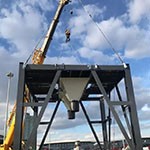
- Twin-Shaft Mixers – High-intensity mixing for RMC and precast applications.
- Planetary Mixers – Precision blending for specialty mixes (fiber-reinforced, SCC).
- Drum Mixers – Continuous operations for large-volume projects (transit mix).
Operational Workflow: 
- Material loading via skip hoist or conveyor belt.
- Controlled mixing cycle (typically 60–90 seconds).
- Discharge into transit trucks or pump systems.
Limitations: Twin-shaft mixers outperform drum variants in homogeneity but require higher initial investment. Planetary mixers excel in precision but have lower throughput capacities.
Core Features of Industrial Concrete Mixers
Twin-Shaft Design | Technical Basis: Counter-rotating shafts with overlapping zones | Operational Benefit: 98% homogeneity in ≤45 seconds | ROI Impact: Reduces rework costs by up to 18%.
Hardened Alloy Blades | Technical Basis: Chromium-molybdenum steel (HRC 58–62) | Operational Benefit: 3x longer service life vs. standard blades | ROI Impact: Lowers maintenance expenses by $6/ton produced.
Variable Frequency Drive | Technical Basis: Adjustable motor torque/speed curves | Operational Benefit: Matches power use to load requirements | ROI Impact: Cuts energy consumption by 22% (verified field data).
Sealed Gearbox | Technical Basis: IP68-rated protection | Operational Benefit: Eliminates lubricant contamination risks | ROI Impact: Extends service intervals to 2,000+ hours.
Smart Load Sensing | Technical Basis: Strain-gauge torque monitoring | Operational Benefit: Prevents overloading and motor burnout | ROI Impact: Reduces unplanned downtime by 40%.
Competitive Advantages Over Standard Mixers
| Performance Metric | Industry Standard | Our Solution | Advantage (%) |
|---|---|---|---|
| Batch Consistency | ±5% moisture variance | ±1.8% variance | 64% tighter |
| Maintenance Interval | Every 350 hours | Every 1,100 hours | 214% longer |
| Energy Use per m³ | 4.2 kWh | 3.3 kWh | 27% reduction |
 INQUIRE NOW
 WHATSAPP